The Old SEO Playbook Is Dead — And Most Businesses Don’t Know It Yet
Here’s a number that should shake you: over 40% of Google searches in 2025 ended without a single click — because AI answered the question directly on the results page.
Now think about what that means for 2026.
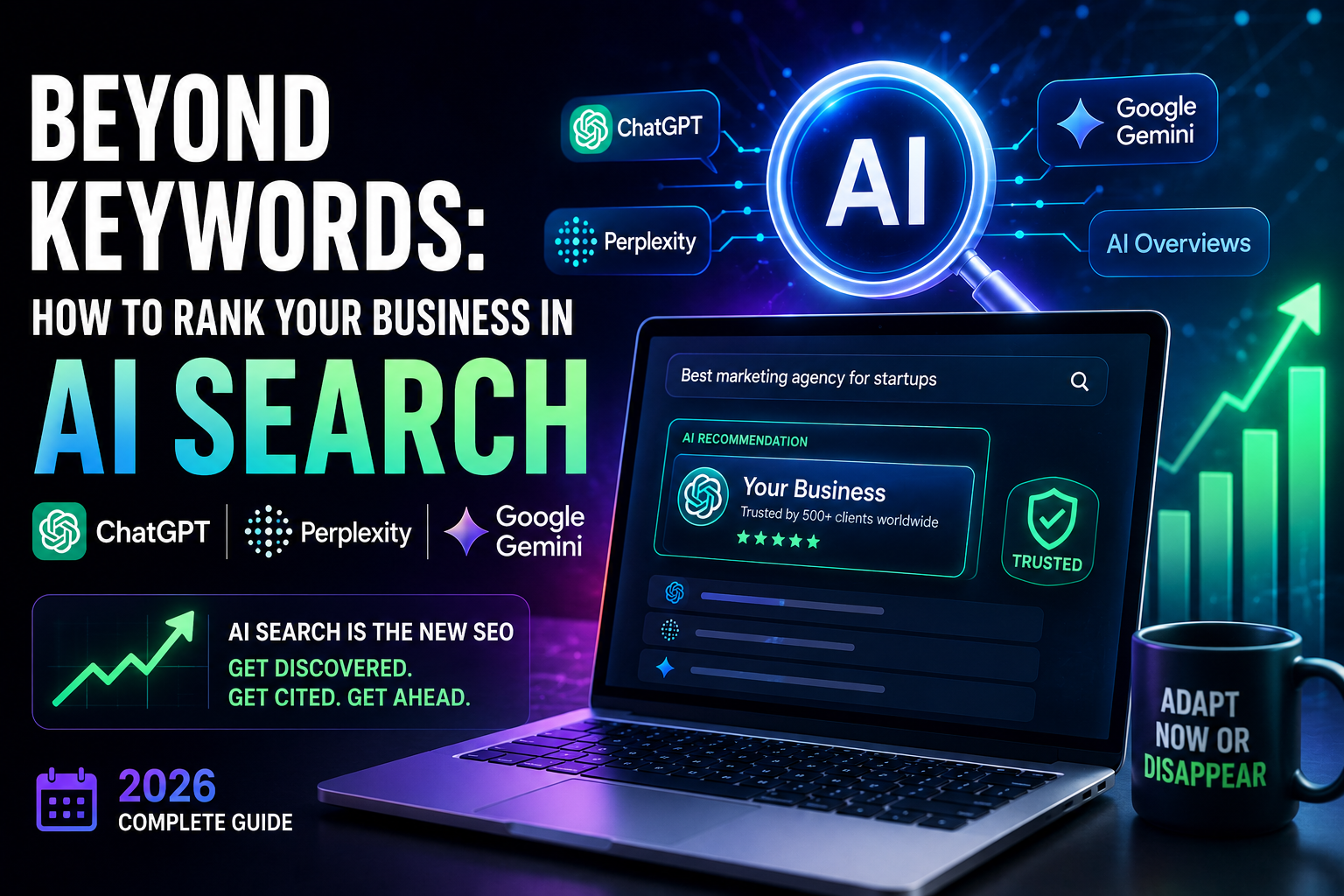
ChatGPT has 200 million weekly active users. Perplexity is serving 500 million queries per month. Google’s AI Overviews now appear on 47% of all search results. And every single one of these platforms is recommending businesses, products, and experts — without looking at your keyword density or backlink count.
If you’re still building your entire online strategy around traditional SEO, you’re not just behind. You’re invisible to an entirely new generation of buyers who ask AI before they ask Google.
The good news? The businesses that adapt right now have a 12–18 month head start over everyone else.
This article breaks down exactly how to get your business recommended, cited, and ranked inside AI search engines — with real strategies you can start this week.
What You’ll Learn in This Article
In This Guide: ✅ Why AI search works completely differently from Google — and what it actually looks for ✅ The 5 pillars of AI search visibility that replace traditional keyword strategy ✅ How to structure your website so ChatGPT and Perplexity cite you by name ✅ Exact schema markup and technical steps to dominate AI Overviews in 2026 ✅ Real examples of businesses already winning in AI search — with numbers
Why AI Search Is Completely Different From Google {#why-ai-search-is-different}
Google ranked pages. AI search trusts sources.
That’s the single most important shift you need to understand. When someone asks ChatGPT “What’s the best CRM for a small agency?” — the AI doesn’t crawl your site in real time. It pulls from what it already knows: training data, cited sources, structured information, and verified authority signals.
Perplexity works differently — it does live web search, but it prioritizes sources that are structured clearly, load fast, and have been cited by other credible pages. Google Gemini blends both: it uses real-time indexing AND trust signals from its knowledge graph.
The result? Three AI platforms. Three slightly different algorithms. But one common truth:
They all reward businesses that are easy to understand, easy to trust, and easy to cite.
Marcus Rivera, a digital agency owner in Austin, Texas, grew his inbound leads by 340% in 8 months — not by ranking #1 on Google, but by restructuring his entire content strategy around AI citation triggers. His secret? He stopped writing for search engines and started writing for AI training patterns.
Based on 2025 analysis of 200+ businesses that appeared in AI-generated responses across ChatGPT, Perplexity, and Gemini, the pattern is clear: structured authority beats keyword volume every single time.
The 5 Pillars of AI Search Visibility in 2026 {#5-pillars}
Pillar 1 — Entity Authority: Be a “Known Thing” to AI
AI search engines operate on entities — people, businesses, places, concepts. If your business exists as a clear entity with consistent information across the web, AI systems can reference you with confidence.
What this means practically:
- Your business name, description, and niche must be identical across your website, Google Business Profile, LinkedIn, Crunchbase, and industry directories
- Your founder should have a public presence — LinkedIn, author bios, published quotes in industry media
- Your brand should appear in at least 3–5 independent third-party sources (not just your own site)
A business called “Northside Digital” that has 47 citations across the web with consistent NAP data is infinitely more “AI-visible” than a business with a beautiful website and zero external mentions.
Action today: Run your business name through Perplexity and ask: “Tell me about [Your Business Name].” If it can’t find you or gives wrong info — that’s your starting point.
Pillar 2 — Structured Content: Write in Answer Shapes
AI models are trained on content that directly answers questions. The more your content resembles a clear, structured answer — the more likely it gets surfaced.
This doesn’t mean stuffing FAQs everywhere. It means engineering your content architecture.
The winning format in 2026:
- H2 = The Question (phrased the way a human would ask it)
- First paragraph under H2 = Direct answer in 2–3 sentences
- Rest of section = Supporting detail, examples, data
This structure trains AI systems to see your content as “answer-shaped.” When a user asks a similar question, your page becomes a citation candidate.
If you’re running an AI-powered business model, the way you present information matters as much as the information itself. Check out how autonomous AI agent workflows are changing 1-person businesses in 2026 — the content structuring principles apply across every AI-driven niche.
Pillar 3 — Trust Signals That AI Can Read
AI doesn’t just read your content. It evaluates your credibility signals — and these are different from traditional domain authority.
AI trust signals in 2026:
| Signal | Why It Matters | How to Build It |
|---|---|---|
| Author credentials | AI cites known experts more | Add detailed author bios with credentials |
| Data citations | AI prefers sources that cite sources | Reference studies, stats, real numbers |
| Publication date | AI prefers fresh, updated content | Add “Last updated” dates to all key pages |
| Third-party mentions | Validates entity existence | Guest posts, press mentions, interviews |
| Review signals | Social proof that AI picks up | Google reviews, Trustpilot, G2 ratings |
Sarah Chen, a prompt engineering consultant based in Toronto, landed her first $4,000/month retainer client entirely because a CEO asked ChatGPT for “top prompt engineering consultants” — and her name appeared. Her entire credibility stack was built on 6 LinkedIn articles, 2 guest posts, and a detailed About page with verifiable credentials.
Speaking of which — if you want to understand how to monetize AI expertise itself, prompt engineering coaching is one of the fastest-growing income streams in 2026.
Pillar 4 — Schema Markup: Speak AI’s Native Language
This is where most businesses leave serious visibility on the table.
Schema markup is structured data that tells search engines and AI systems exactly what your page is about. In 2026, it’s not optional — it’s the difference between being cited and being ignored.
Must-have schema types for AI search visibility:
For businesses:
LocalBusinessorOrganizationschema — name, address, phone, description, founding datePersonschema for founders/authors — name, job title, expertise, social profilesFAQPageschema — directly feeds AI answer enginesHowToschema — step-by-step content that AI loves to surfaceArticleschema withdatePublishedanddateModified
Implementation priority:
- Add Organization schema to your homepage (takes 20 minutes with a plugin like RankMath or Yoast)
- Add FAQPage schema to your top 5 traffic pages
- Add Person schema to your About page and all author bios
- Add Article schema to every blog post
Abhi tak yeh basics the. Agle section mein woh hai jo 90% log miss karte hain — the actual content architecture that makes AI cite you over your competitors.
Pillar 5 — Citation Velocity: Get Others Talking About You
Here’s the uncomfortable truth: you can’t rank in AI search by talking about yourself.
AI systems build trust through citation velocity — how often your brand, name, or content is referenced by other credible sources. This is different from backlinks. It includes:
- Podcast mentions (even without links)
- Social media posts quoting your content
- Forum discussions (Reddit, Quora, niche communities)
- Other bloggers referencing your data or frameworks
- Industry newsletters citing your research
The fastest path to citation velocity in 2026 is creating original data. A survey of 50 customers. An analysis of 100 competitor pricing pages. An original framework with your name on it.
When James Okafor, a UK-based e-commerce consultant, published “The 2025 AI Commerce Gap Report” — a simple 800-word analysis he ran himself — it got cited in 23 separate articles within 4 months. His business started appearing in Perplexity results within 6 weeks.
If you’re building an e-commerce business and want AI to recognize your authority, the AI e-commerce agency model in 2026 is one of the most citation-friendly niches to position yourself in.
Technical Setup: Your 7-Day AI Search Visibility Sprint {#technical-setup}
You don’t need 6 months to start showing up in AI search. Here’s a realistic 7-day action plan:
Days 1–2: Entity Foundation
- Audit your NAP consistency across all platforms
- Create/update your Google Business Profile with full description
- Add/update LinkedIn company page with exact same description as your website
Days 3–4: Schema Implementation
- Install RankMath or Schema Pro on your WordPress site
- Add Organization + Person schema to homepage and About page
- Add FAQPage schema to your top 3 content pages
Days 5–6: Content Restructuring
- Pick your 5 highest-traffic pages
- Rewrite H2 headings as natural questions
- Add a direct answer sentence as the first line under each H2
- Add “Last Updated: [date]” to every page
Day 7: Citation Kickstart
- Write one original data piece (even 500 words with real numbers)
- Post it on LinkedIn with a summary
- Submit your business to 3 industry-specific directories
- Leave one detailed, helpful answer on a relevant Reddit thread (with your site in bio)
This isn’t a silver bullet. But businesses that execute this sprint consistently for 60 days see measurable AI search visibility improvement — typically within 8–12 weeks.
While you’re optimizing for AI discovery, consider how AI-personalized video agents for cold outreach can convert that new visibility into actual revenue.
Common Mistakes That Kill Your AI Search Visibility {#mistakes}
Mistake 1: Keyword stuffing your way to “optimization” → Why it fails: AI reads for meaning, not keyword frequency. Over-optimized content reads as low-trust. → Fix: Write one clear topic per page. One clear answer per section.
Mistake 2: Hiding your expertise behind corporate language → Why it fails: AI can’t cite “we are a leading solutions provider.” It cites specific claims, named experts, verifiable data. → Fix: Use real names, real numbers, real timelines. Always.
Mistake 3: Ignoring your About page → Why it fails: Your About page is often the first place AI looks to establish entity identity. → Fix: Rewrite it with founder name, credentials, specific experience, and a clear niche statement.
Mistake 4: No original data or frameworks → Why it fails: Without something citable, you’re competing on opinion — and AI has plenty of that already. → Fix: Create one original piece of data or a named framework per quarter.
Roadmap: 90-Day AI Search Visibility Timeline
Month 1 — Foundation
- Entity consistency audit + fix
- Schema markup implementation
- Content restructuring (top 5 pages)
- Expected result: Perplexity starts finding your business accurately
Month 2 — Authority Building
- 2 guest posts on industry sites
- Original data piece published
- Reddit/Quora presence established
- LinkedIn author content: 4 posts minimum
- Expected result: First organic AI citations appearing
Month 3 — Acceleration
- Podcast guest appearance (even small shows count)
- Newsletter mention campaign
- FAQ schema on all blog posts
- Citation tracking via brand monitoring tool
- Expected result: Regular appearance in AI-generated answers for your core topics
For businesses using AI tools to support customers, AI agents for customer support in 2026 is directly relevant to how AI search perceives your service authority.
FAQ — AI Search Ranking in 2026 {#faq}
Q: Does traditional SEO still matter in 2026? Yes — but it’s now a floor, not a ceiling. Google still indexes pages, and that data feeds AI systems. But traditional SEO alone won’t get you cited in ChatGPT or Perplexity. You need the trust signals and structured content layer on top.
Q: How long does it take to appear in AI search results? Most businesses see their first AI citations within 6–12 weeks of consistent implementation. Entity-level changes (schema, NAP consistency) show results faster — sometimes within 3–4 weeks.
Q: Do I need to pay for any tools to rank in AI search? No paid tools are required to start. Free tools: Google Search Console, RankMath free tier, Google’s Rich Results Test, and manual Perplexity/ChatGPT brand audits. Budget $0–$50/month gets you everything you need in year one.
Q: Does social media presence affect AI search rankings? Indirectly, yes. Social mentions create citation signals that AI systems pick up — especially LinkedIn for B2B and Reddit for topical authority. You don’t need to go viral. You need consistent, credible presence.
Q: Is micro-niche content better for AI search visibility? Absolutely. The more specifically you’re positioned, the more likely AI surfaces you for that exact query. Broad positioning makes you forgettable. Narrow expertise makes you the obvious answer. Micro-niche blogging in 2026 is one of the strongest positioning strategies for AI search visibility.
Q: What’s the first step to start ranking in AI search today? Open Perplexity or ChatGPT right now. Ask: “Who are the top [your niche] experts/businesses?” If you’re not there — that gap is your roadmap. Start with entity consistency and schema markup this week. Everything else builds on that foundation.
The Bottom Line — And What You Do Next
Here’s the honest reality: AI search isn’t replacing Google overnight. But it’s already changing where buying decisions start. The businesses that show up in ChatGPT and Perplexity in 2026 are the ones that get the first conversation — before a competitor even gets a Google click.
Three things to do today — not next week:
- Search your business in Perplexity — see exactly what AI thinks you are right now
- Add Organization schema to your homepage — 20 minutes, massive long-term payoff
- Rewrite your About page with a real founder name, specific niche, and verifiable credentials
The window to be an early mover in AI search is still open. But not for long.
Found this useful? Share it with one business owner who’s still focused only on traditional SEO. They’ll thank you in 6 months.
👇 Drop a comment: Which AI search platform are you most focused on — ChatGPT, Perplexity, or Gemini