Let me tell you something the e-commerce industry does not like to admit.
Most small sellers are not losing because of bad products.
They are losing because their photos look terrible.
A Shopify study from 2025 found that listings with professional product images convert at 3.4x the rate of listings with amateur photos.
3.4x.
That is not a small edge. That is the difference between a business that grows and one that quietly dies.
And here is the problem — a professional photoshoot in India costs ₹15,000 to ₹50,000 per session. In the US or UK, you are looking at $500 to $2,000. For most small sellers? That number is simply impossible.
So they stay stuck. Bad photos. Low conversions. Frustrated.
That frustration — right there — is the business opportunity.
Because in 2026, you do not need a camera, a studio, or a photographer to produce professional product images.
You need three AI tools and about two hours.
Riya Kapoor figured this out in Lucknow. No design degree. No photography background. She learned Pebblely and Booth.ai over three weeks, took on her first two clients for free to build a portfolio, and by Month 6 she had eight paying clients and was clearing ₹1.85 lakh per month.
No camera. No studio. No editing team.
Just AI tools, smart positioning, and a market that desperately needed what she was offering.
This guide will show you the exact system she used.
What You Will Learn:
✅ What an AI E-commerce Agency actually is — and why 2026 is the right time
✅ The exact AI toolkit — product photography, listing copy, store building
✅ What to charge — specific pricing tiers with income math
✅ Where to find clients — four strategies with real outreach scripts
✅ Month-by-month roadmap to ₹2 lakh per month
✅ The four mistakes that kill most beginners in the first 90 days
Jump to: What It Is | The Toolkit | Pricing | Finding Clients | Roadmap | FAQ
What Is an AI E-commerce Agency — And Why Now? {#concept}
Simple version: you help online sellers look professional using AI tools.
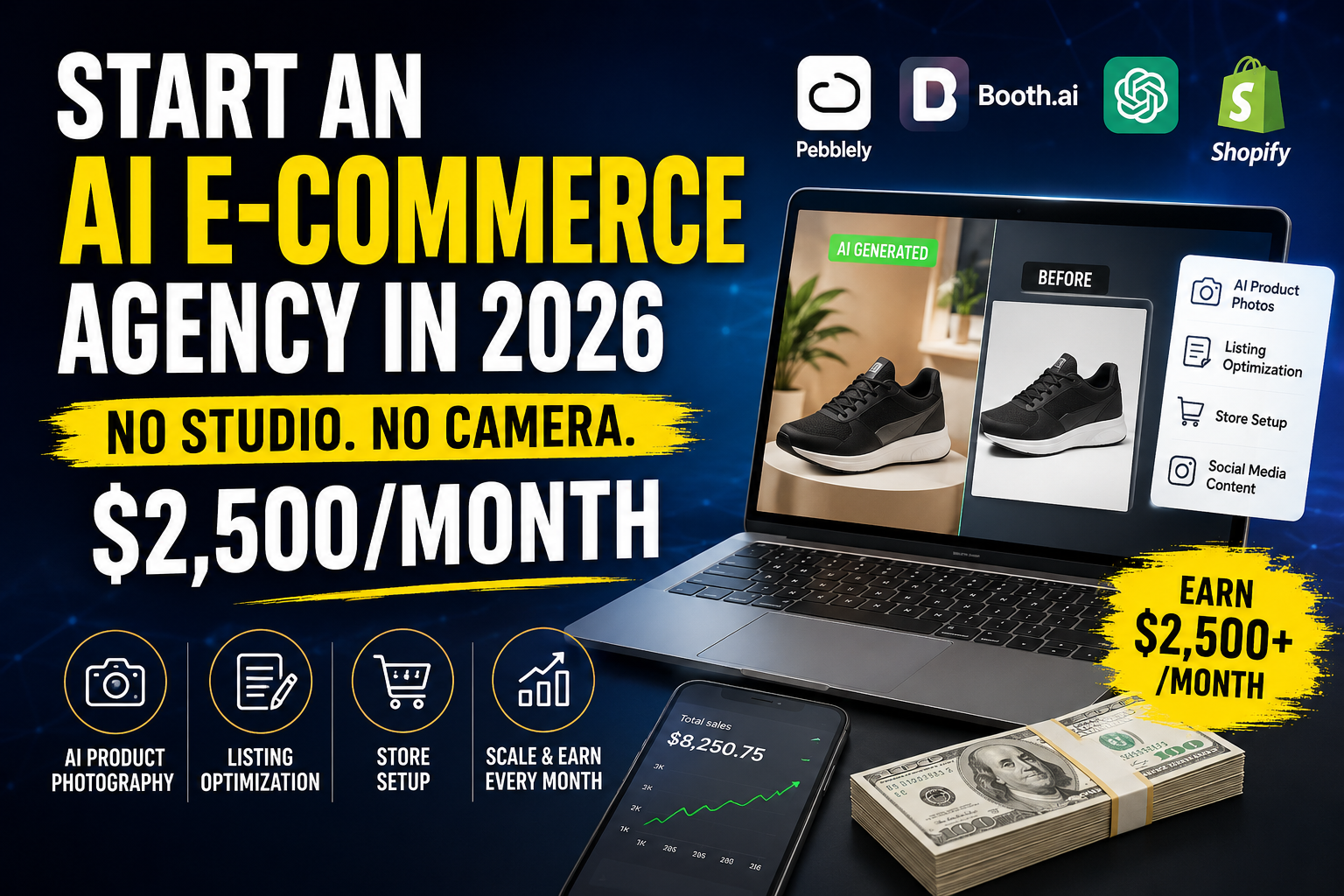
Product photos. Listing copy. Store design. Social media content. All of it — built with AI. Delivered fast. Priced below what traditional agencies charge.
You are not the designer. You are the operator.
The AI does the heavy lifting. You do the thinking, the quality control, and the client relationship.
Why is this a real business in 2026?
Three reasons — and all three matter.
First: the demand is genuinely massive. India added 40 million new online shoppers in 2025 alone. Tier 2 and Tier 3 cities are exploding with first-time sellers — artisans, textile traders, home bakers, handicraft makers. They want to sell online. They have no idea how to look professional. They cannot afford agencies that charge ₹50,000 for a photoshoot.
That is your market.
Second: the technology actually works now. Two years ago, AI product photography was obviously fake — weird shadows, unnatural edges, flat lighting. In 2026, Pebblely and Booth.ai produce images that pass Amazon’s and Flipkart’s quality guidelines without issue. The quality gap between AI and traditional photography has essentially closed for standard product categories.
Third: most agencies have not caught up yet. Walk into any traditional creative agency today and ask them to shoot 10 products for ₹8,000 with 48-hour delivery. They will laugh. You can do it — and deliver results they cannot match at that price point.
To understand the broader trend driving all of this — AI content automation is reshaping how every kind of business creates and manages content. E-commerce is just the most visible example.
The AI Toolkit — What You Actually Need {#tools}
Forget the YouTube videos telling you to install 15 different tools.
You need five categories covered. One or two tools per category. That is it.
1. AI Product Photography
This is your core service. This is what clients will pay you for first.
Pebblely — Start here.
Upload any product photo against any background. Pebblely removes the background and replaces it with a studio-quality scene. Over 100 options — marble, wood, white, outdoor, lifestyle. Output meets Amazon’s pure white background requirement out of the box.
Pricing: $19/month for 200 images.
Real-world output: Consistently usable on Amazon and Flipkart without retouching.
Limitation: Best for packaged goods, beauty, food, and home products. Less ideal for clothing on models.
Booth.ai — For lifestyle shots.
Places your product inside a contextual scene. A protein powder jar on a gym shelf. A candle on a bathroom counter. A notebook on a morning desk. These contextual images typically outperform plain white backgrounds for conversion — especially on Instagram and branded store pages.
Mokker — For print-on-demand and merchandise.
T-shirts, mugs, tote bags, phone cases — Mokker places your design onto photorealistic product mockups instantly. Essential if you work with any seller in the custom merchandise space.
My actual workflow for a 10-product photography project:
Step 1 — Client sends me product images (phone photos are fine as raw material).
Step 2 — I run each image through Pebblely: white background version + two lifestyle options.
Step 3 — I quality-check every single output manually. AI gets it wrong about 15% of the time — edges, color shifts, proportion issues.
Step 4 — I run the best lifestyle images through Booth.ai for the hero shots.
Step 5 — I deliver a Dropbox folder: white BG (Amazon), lifestyle (Instagram/store), hero shot (homepage).
Total time per 10 products: 4 to 6 hours.
Client’s alternative: ₹25,000 photoshoot + 2-week wait.
Your delivery: ₹10,000 + 48 hours.
That is the pitch. And it basically sells itself.
2. AI Listing Copy
Great photos get the click. Great copy closes the sale.
ChatGPT with a custom prompt template is the backbone here.
The prompt I use for Amazon listings:
“You are an expert Amazon copywriter. Write a product listing for [product name]. Target buyer: [describe]. Key features: [list 5]. Brand tone: [friendly/professional/premium]. Include: a keyword-rich title under 200 characters, five benefit-led bullet points, and a 250-word description that opens with a problem the buyer faces. Naturally include these keywords: [list].”
Run this once. Tweak the output. Done in 12 minutes per product.
For Flipkart: shorter titles, more conversational bullet points, Hindi-friendly phrasing works better for Tier 2 audiences.
This is where AI content automation creates real leverage. A workflow that used to take 3 hours per product now takes 15 minutes — without sacrificing quality.
Jasper AI — Worth using for clients who need volume. E-commerce templates are solid and faster than manual prompting when you are handling 50+ products per month.
3. Store Building
Not every client sells on Amazon or Flipkart. Many want their own storefront.
AI website builders have genuinely changed what is possible here without coding.
Shopify with AI apps — Zyper for content, Tidio for customer support, Magic for product descriptions — gets you a complete, functional store in two to three days. For Indian sellers who want UPI-first checkout and Hindi interface, Dukaan is faster and more practical.
Typical store setup timeline in my workflow:
- Day 1: Theme selection, homepage layout, navigation structure
- Day 2: Product page setup, payment gateway, mobile optimization
- Day 3: QA, speed testing, SEO basics, client walkthrough
4. Social Media Content
Canva AI for static posts and story formats. AdCreative.ai for paid ad creatives — it is purpose-built for e-commerce and analyzes what performs in your product category before generating.
One underrated add-on: if you develop skills in AI pattern and texture design, packaging design and product label creation becomes a premium bolt-on service. That alone adds ₹5,000 to ₹15,000 per project with minimal extra time.
5. SEO and Listing Optimization
Helium 10 for Amazon keyword research and listing scores. Semrush for organic search if clients have their own store. Both have free tiers that are genuinely useful when you are starting out.
Pricing — What to Charge and How to Package It {#pricing}
The biggest mistake beginners make: charging by the hour.
Package everything. It makes your service feel like a product — not a negotiation.
Package 1: AI Product Photography
10 products × 5 images = 50 professional photos.
White background + 2 lifestyle + 1 hero shot per product.
Manual quality review included.
Delivery: 48 hours.
Price: ₹8,000 to ₹15,000
Rush (24 hours): add ₹3,000
Package 2: Complete Listing Optimization
10 products — title, 5 bullets, full description, backend keywords.
Amazon or Flipkart format.
One revision round included.
Price: ₹12,000 to ₹20,000
Package 3: Online Store Setup
Full Shopify or Dukaan store.
Homepage, up to 50 product pages, payment gateway, basic SEO.
Mobile-optimized. Client training call included.
Price: ₹25,000 to ₹60,000
Package 4: Monthly Management Retainer ← Most Important
20 new product listings per month.
12 social media posts.
Monthly performance report.
WhatsApp support for urgent updates.
Price: ₹15,000 to ₹30,000/month
This is your foundation. Six retainer clients at ₹20,000 = ₹1,20,000/month. Guaranteed. Recurring. Predictable.
Everything else is upside.
Package 5: Ad Creative Set
10 Facebook/Instagram creatives. Three A/B variations each. All platform sizes.
Price: ₹8,000 to ₹15,000
The ₹2 Lakh Monthly Math
| Service | Volume | Rate | Income |
|---|---|---|---|
| Monthly Retainer | 6 clients | ₹20,000 | ₹1,20,000 |
| Store Setup | 2 projects | ₹35,000 | ₹70,000 |
| Photo Packages | 3 one-time | ₹10,000 | ₹30,000 |
| Total | ₹2,20,000 |
This is a Month 9 to 10 target — not Month 1. Anyone telling you otherwise is selling something.
Finding Clients — Four Strategies That Actually Convert {#clients}
Strategy 1: The Amazon Seller Audit (Highest Converting)
Browse Amazon India in your chosen product category.
Look for sellers with good review counts but poor listing quality. Three to four-star sellers with blurry photos and thin descriptions. They have already proven they can sell — they just need better presentation.
Find them on LinkedIn or in Facebook groups like “Amazon Sellers India” or “Flipkart Seller Community.”
Your opening message:
“Hey [Name] — I came across your [product] on Amazon. Strong reviews, genuinely good product. But the images are holding you back — they do not match the quality of what you are actually selling.
I work with small sellers to fix exactly this using AI photography tools. I can show you what your product could look like — no cost, no commitment. Want me to run one image through the tool and send you the before/after?”
The free sample closes this conversation more often than any pitch ever will.
Strategy 2: Instagram Seller DMs
Search: #handmadeindia #shopsmallIndia #IndianEtsy #[your niche]India
Filter for sellers with interesting products but inconsistent, poorly lit phone photography.
Four-sentence DM. Free transformation offer. No pitch.
That is the whole strategy.
Strategy 3: Physical Market Visits
Surat textile market. Jaipur handicraft lanes. Delhi’s Sadar Bazaar. Moradabad brassware district.
These places are full of sellers who want to go online. They are not on LinkedIn. They are in their shops.
Show up with a tablet. Show your portfolio. Explain what you do in plain language. Leave a card.
Face-to-face trust conversion is dramatically higher than cold digital outreach — especially with first-time online sellers.
Strategy 4: Referral Program
After your first three clients are happy — launch a simple referral incentive.
Every client who sends you a new client gets 10% of that new project’s first invoice.
One happy seller talks to three others. That is how agencies scale in India without an advertising budget.
Month-by-Month Roadmap {#roadmap}
Month 1 to 2 — Foundation
Learn Pebblely, Booth.ai, Canva AI, ChatGPT prompting. Practice on 20 products around your home. Build a before/after portfolio of 15 strong examples. Set up Instagram, LinkedIn, and a one-page website.
Do two to three free projects for real sellers — with written permission to use results publicly.
Learning ChatGPT income strategies at this stage will sharpen your listing copy workflow faster than anything else.
Expected income: ₹0 to ₹20,000
Month 3 to 4 — First Paying Clients
Start outreach — 30 to 50 messages per day across Amazon seller communities, Instagram, and local markets.
Lead with the free sample offer. Convert conversations into paid packages. Target: three to five paying clients by end of Month 4. At least two on monthly retainers.
Expected income: ₹30,000 to ₹70,000
Month 5 to 6 — Shift to Retainers
Convert every one-time client into a monthly retainer conversation.
“I can manage your new listings and content going forward so you never have to think about it.”
The AI agent arbitrage model is essentially what you are doing here — combining multiple AI tools to deliver high-value output that would cost clients far more to source separately. That is your pricing power.
Target: five to six active retainer clients.
Expected income: ₹80,000 to ₹1,30,000
Month 7 to 9 — Add Income Streams
Join AI SaaS affiliate programs for every tool you recommend — Shopify, Pebblely, Jasper. You are already recommending these to clients. You might as well earn a commission when they sign up.
Hire a part-time virtual assistant (₹8,000 to ₹12,000/month) for repetitive tasks — image resizing, listing uploads, social scheduling. This frees you for sales.
Expected income: ₹1,20,000 to ₹1,70,000
Month 10 to 12 — ₹2 Lakh and Beyond
Retainers are your base. Project income is upside. Affiliate commissions are passive.
The business now runs on systems — not just hustle.
Building sustainable AI income is a long game. The e-commerce agency model gets you to ₹1 lakh faster than almost any other path — and ₹2 lakh is a natural extension of the same system.
Expected income: ₹1,80,000 to ₹2,40,000+
Four Mistakes That Kill Beginners Early
Mistake 1: Offering everything from day one.
It signals inexperience, not capability. Start with AI product photography and listing copy. Master those two. Add services only when you have results to show.
Mistake 2: Working for free for too long.
Two or three portfolio projects — reasonable. Anything beyond that is self-sabotage. After your portfolio is built, charge. Even low rates. But charge.
Mistake 3: Skipping manual quality review.
AI tools get it wrong roughly 15% of the time — unnatural edges, color drift, proportion issues. Every image needs a human eye before delivery. Your reputation is built one delivery at a time. One bad batch can cost you a client and three referrals.
Mistake 4: Going fully digital with outreach.
DMs and emails are slow. For India’s small seller market — physical market visits, local networking, face-to-face demos convert dramatically faster. Block one day per week for offline outreach. Bring your laptop. Show the before/after live.
FAQ {#faq}
Do I need a design or photography background?
No. Pebblely and Booth.ai are drag-and-drop tools. What matters is attention to detail — the ability to spot when an output looks off. That is a learnable skill. Most people have it after two weeks of consistent practice.
Will Amazon accept AI-generated product images?
Yes — if you follow their technical guidelines. Pure white background, minimum 1000×1000 pixels, product filling 85% of the frame. Pebblely’s output meets all three requirements. Always verify current platform guidelines before client delivery.
How long does a typical project take?
A 10-product photography package takes 4 to 6 hours of actual work including generation, quality review, and file organization. Add 3 to 4 hours for listing copy. You can deliver both comfortably in 48 hours as a solo operator.
Can I run this alongside a full-time job?
Yes — especially in Months 1 to 4. The work is async, deadline-driven, and flexible. Most people transition full-time around Month 5 to 7 when retainer income matches their salary.
What is the single most important thing in the first 30 days?
Build a portfolio that shows clear, specific before-and-after transformations. Not design theory. Not tool screenshots. Actual product images — bad version, AI version, side by side. When a potential client sees what you did to a product similar to theirs, the sales conversation takes care of itself.
Conclusion
Here is the honest version.
This is not a passive income scheme. The first three months will feel slow. Outreach feels uncomfortable. Free work feels unfair.
But the model works — because the problem it solves is real, the tools actually deliver, and the market is genuinely underserved.
Most small sellers still cannot afford traditional agencies. That is not going to change. What has changed is that you can now deliver professional-quality output at a price point they can actually afford — and do it in 48 hours instead of two weeks.
That is the entire business.
Three things to do right now: Sign up for a free Pebblely account. Find one product around your home. Run it through the tool and look at the output. Then find three sellers on Amazon or Instagram whose products deserve better photos. Those are your first three conversations.
The rest follows from there.
What product category are you thinking of targeting first — fashion, food, beauty, handicrafts, or electronics? Drop it in the comments and I will give you the specific tools and outreach angle for that niche.