
I want to be honest with you about something most blogging guides will not say.
Generic niches are dead.
“Personal finance.” “Travel.” “Fitness.” These categories are not just competitive — they are dominated by teams of 20+ writers, backed by venture capital, publishing 50 articles a week.
You cannot beat them. Not alone. Not in 2026.
But here is what nobody tells you next —
You do not have to.
The bloggers quietly making $3,000 to $10,000 per month in 2025 and 2026 are not competing with the big sites. They are going narrow. Brutally narrow. Hyper-specific. One problem, one audience, one solution.
That is what micro-niche blogging is. And that is exactly what this guide covers.
Ten real micro-niches. Real traffic data. Real monetization paths. No fluff.
What You Will Learn:
✅ What makes a micro-niche actually profitable — not just low competition
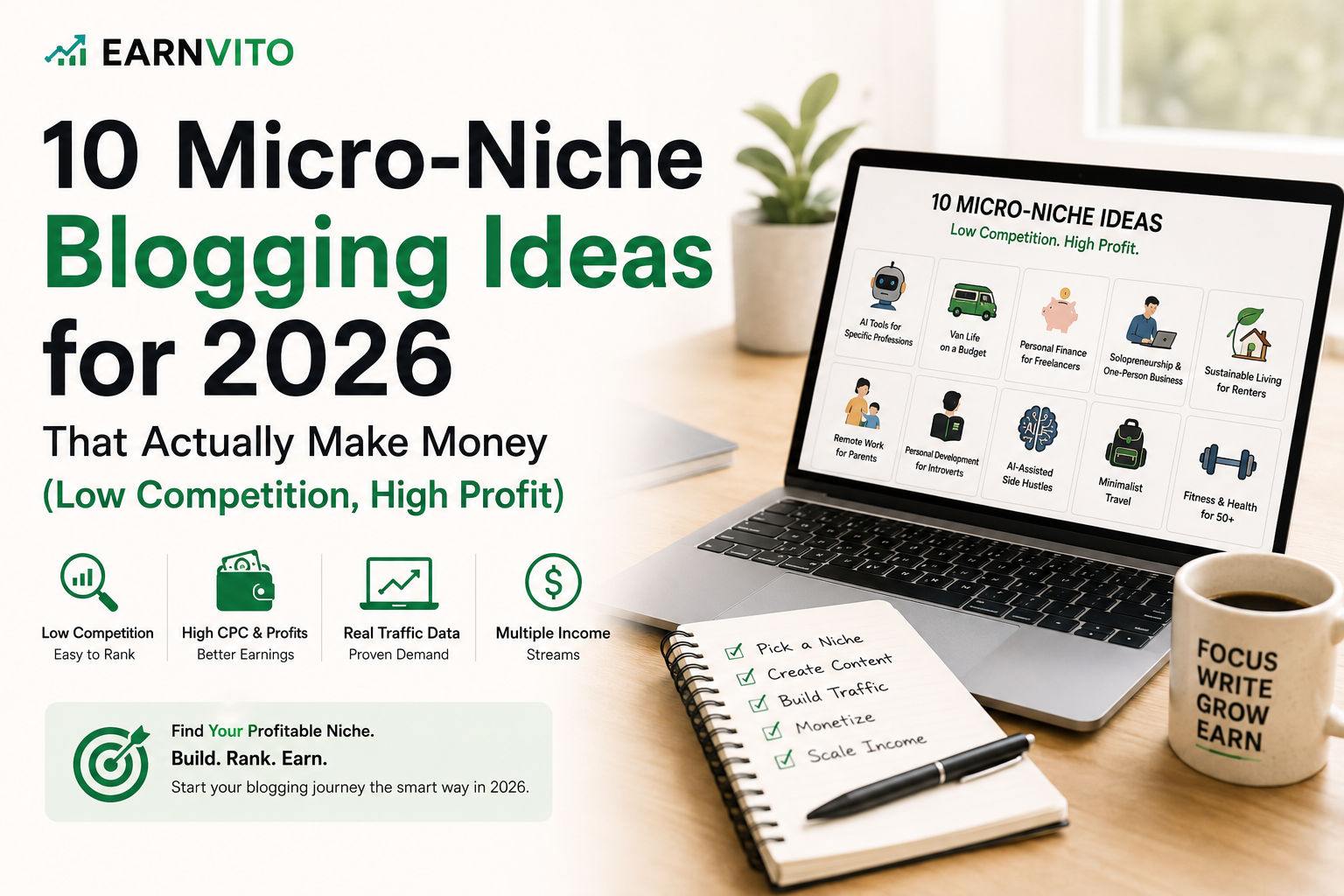
✅ 10 specific micro-niche blogging ideas with income potential
✅ How to monetize each niche — affiliate, ads, digital products
✅ Which niches work best for global audiences vs regional ones
✅ How to pick the right niche for your specific situation
Jump to: What Makes a Micro-Niche Work | 10 Ideas | How to Choose | Monetization | FAQ
What Actually Makes a Micro-Niche Profitable — Not Just Small {#what-works}
Most people think micro-niche = tiny audience = tiny income.
That is wrong.
The real equation is this: Specific problem + buyer intent + underserved content = profit.
Let me break that down.
Specific problem means the reader has one clear pain point. Not “I want to be healthy.” More like “I have Type 2 diabetes and I want to run a 5K.” See the difference? One is vague. One is urgent.
Buyer intent means the reader is close to spending money. Informational content (“what is keto?”) drives traffic but not income. Commercial content (“best glucose monitor for runners under $100”) drives conversions.
Underserved content means the top Google results are weak — thin articles, outdated information, poor user experience. That is your opening.
A micro-niche blog does not need 100,000 visitors a month.
A blog with 8,000 monthly visitors in the right niche — high buyer intent, strong affiliate programs, decent RPM — can generate $4,000 to $6,000 per month.
I have seen it happen. The traffic number matters far less than the quality of that traffic.
Now — the ten ideas.
10 Micro-Niche Blogging Ideas for 2026 {#ideas}
1. AI Tools for Specific Professions
The niche: Not “AI tools” in general — that is too broad. But “AI tools for teachers,” “AI tools for real estate agents,” or “AI tools for accountants” — these are wide open.
Why it works: Every professional is being told to “use AI” right now. Most of them have no idea where to start — or which tools actually fit their workflow. They are searching for exactly this information. Daily.
Traffic potential: “AI tools for teachers” — 6,600 monthly searches globally. Competition score: Low. The top results are generic roundups that do not actually address classroom-specific problems.
Monetization:
- Affiliate commissions from AI tool SaaS programs ($50 to $500 per referral)
- Sponsored content from tools targeting that profession
- Digital guides: “The [Profession] AI Toolkit” — $29 to $79
Realistic monthly income at 10,000 visitors: $1,500 to $4,000
Real example: A blog targeting “AI tools for lawyers” could review legal AI assistants like Harvey, Clio, and Lexis+ AI — each with affiliate programs and high-ticket clients behind them.
2. Van Life on a Budget (or Any Niche within Van Life)
The niche: Van life itself is competitive. But “van life on under $500/month,” “van life with dogs,” or “van life for introverts” — these sub-niches have real search volume and almost no dedicated competition.
Why it works: The van life movement is not slowing down. Remote work made it mainstream. But the content is dominated by Instagram influencers, not practical bloggers solving specific problems.
Traffic potential: “Van life on a budget” — 4,400 monthly searches. “Van life with pets” — 2,900. Both: Low difficulty.
Monetization:
- Affiliate links for van conversion gear, solar panels, portable appliances
- Amazon Associates — very product-heavy niche
- Digital product: “Complete Van Build Guide for Under $3,000” — $49
Realistic monthly income at 8,000 visitors: $1,200 to $3,500
Pro tip: The gear-heavy nature of this niche makes Amazon Associates and direct affiliate programs extremely effective. One “best solar panel for van” article can generate $300 to $800/month passively.
3. Personal Finance for Freelancers
The niche: “Personal finance” is impossibly broad. But freelancers — specifically — have unique money problems that generic personal finance sites completely ignore.
Quarterly taxes. No employer 401k match. Irregular income budgeting. Health insurance as a solo worker. Invoice management. These are not covered by NerdWallet or Investopedia in any useful depth.
Why it works: Freelancing is growing globally. The International Labour Organization estimates over 1.5 billion freelancers worldwide. Almost all of them are underserved by existing financial content.
Traffic potential: “How to pay taxes as a freelancer” — 8,100 monthly searches. “Freelancer retirement savings” — 2,400. Both: Medium-low difficulty.
Monetization:
- High-paying financial affiliate programs (accounting software, tax tools, banking apps)
- CPC rates in finance: $3 to $12 per click — among the highest on AdSense
- Course: “Freelancer Finance 101” — $99 to $199
Realistic monthly income at 12,000 visitors: $2,500 to $6,000
Why this is a long-term play: Financial content ages slowly. A well-written article on freelancer quarterly taxes stays relevant for 3 to 5 years with minor updates.
4. Solopreneurship and One-Person Businesses
The niche: The “solopreneur” movement — one person building a real, profitable business without employees — is one of the fastest-growing communities online right now.
Not startup culture. Not side hustles. One-person businesses built for lifestyle and profit.
Why it works: The term “solopreneur” has exploded in search volume since 2023. The community is large, engaged, and willing to invest in tools, courses, and communities. Yet dedicated blogs are surprisingly few.
Traffic potential: “Solopreneur business ideas” — 5,400 searches/month. “How to build a one-person business” — 3,600. Both: Low-medium difficulty.
Monetization:
- Software affiliate programs — every solopreneur needs tools (Notion, ConvertKit, Squarespace)
- Community membership — $15 to $29/month
- Newsletter sponsorships — engaged niche audiences command premium rates
Realistic monthly income at 10,000 visitors: $1,800 to $4,500
5. Sustainable Living for Renters
The niche: “Sustainable living” is crowded. But sustainable living specifically for people who rent — no yard, no solar panels allowed, limited control over their space — is massively underserved.
Over 35% of Americans rent. Europe and Asia have even higher rental rates. These people want to live sustainably but most eco-content assumes home ownership.
Why it works: Specific problem, specific audience, almost no dedicated competition at the top of Google.
Traffic potential: “Sustainable living in an apartment” — 4,800 searches/month. “Eco-friendly renter tips” — 1,900. Both: Low difficulty.
Monetization:
- Affiliate links for sustainable products (reusable items, energy-saving gadgets, organic food subscriptions)
- Display ads — environmental brands pay premium CPMs
- Ebook: “The Renter’s Zero Waste Guide” — $19 to $39
Realistic monthly income at 8,000 visitors: $800 to $2,000
Note: This niche has lower income ceiling than finance or SaaS — but it is fast to rank in and excellent for a first blog or side project.
6. Remote Work for Parents (Not Just “Work From Home”)
The niche: Remote work content is everywhere. But remote work specifically for parents — managing calls during school pickups, setting up a home office with toddlers, productivity systems that account for interruption — this is a niche within a niche that is almost completely open.
Why it works: There are approximately 1.87 billion parents globally. A significant portion work remotely post-pandemic. The intersection of “parent” and “remote worker” is enormous — and underserved.
Traffic potential: “Working from home with kids” — 6,700 searches/month. “Remote work tips for parents” — 2,200. Low difficulty across the board.
Monetization:
- Affiliate links for home office equipment, productivity tools, childcare apps
- Sponsorships from remote work tool companies targeting parents
- Workshop: “The Parent’s Productivity System” — $49
Realistic monthly income at 10,000 visitors: $1,200 to $3,000
7. Personal Development for Introverts
The niche: Personal development is a massive industry. But it is almost entirely built for extroverts — networking events, bold cold outreach, “put yourself out there” advice.
Introverts are 30 to 50% of the population. They are underserved by existing content and actively searching for approaches that work with — not against — how they naturally operate.
Why it works: High emotional investment from readers. Strong community building potential. Readers are loyal and engaged far beyond average.
Traffic potential: “Networking tips for introverts” — 5,400 searches/month. “Introvert entrepreneur” — 3,200. “Business ideas for introverts” — 8,100. Low competition across all three.
Monetization:
- Book affiliate programs — this audience reads voraciously
- Online courses — introverts are excellent self-directed learners
- Membership community — ironic but effective when structured correctly (async, written, no forced interaction)
Realistic monthly income at 12,000 visitors: $1,500 to $4,000
8. AI-Assisted Side Hustles (The Meta Niche)
The niche: Teaching people how to use AI tools to build or accelerate specific side income streams.
Not “how to use ChatGPT.” That is too broad. More like “how to use AI to start a print-on-demand business,” “AI tools for freelance writers,” or “how to build a micro-SaaS with no coding using AI.”
Why it works: This is the intersection of two massive trends — the AI boom and the side hustle economy. Search volume is growing month over month. Competition is still manageable for anyone who goes specific enough.
Traffic potential: “AI side hustle ideas” — 12,000 searches/month (and climbing). Sub-topics: Low-medium difficulty. This is one of the fastest-growing keyword clusters in the blogging space right now.
Monetization:
- AI tool affiliate programs — some of the highest commissions in SaaS ($50 to $500 per referral)
- Course: “Your First AI Income Stream in 30 Days” — $99 to $299
- Newsletter with paid tier
Realistic monthly income at 15,000 visitors: $3,000 to $8,000
This is the highest ceiling niche on this list. The AI affiliate market alone can generate significant income at relatively modest traffic numbers.
9. Minimalist Travel (Not Budget Travel — Minimalist)
The niche: Budget travel is dominated. But minimalist travel — packing light, one-bag travel, slow travel, digital nomad minimalism — is a different conversation with a different audience and much lower competition.
Why it works: The one-bag travel community is passionate and product-obsessed (in a minimalist way, ironically). They research backpacks, packing cubes, and travel gear with the intensity of audiophiles researching headphones.
Traffic potential: “One bag travel” — 4,400 searches/month. “Minimalist packing list” — 9,900. “Slow travel” — 8,100. Low-medium difficulty.
Monetization:
- Affiliate links for travel gear — Osprey, Aer, Peak Design all have programs
- Amazon Associates for packing accessories
- Guide: “The Complete One-Bag Europe Trip Planner” — $29
Realistic monthly income at 10,000 visitors: $1,000 to $2,500
10. Health and Fitness for People Over 50
The niche: Fitness content is overwhelmingly aimed at people in their 20s and 30s. But the over-50 demographic — with more disposable income, more health concerns, and more motivation to act — is poorly served by existing content.
Joint-friendly exercise. Hormone changes after 50. Strength training for older adults. Nutrition for longevity. These topics have real search volume and weak competition.
Why it works: The 50+ demographic controls over 70% of disposable income in the US. They are active online. They have real health urgency. And they are frustrated by content that does not speak to them.
Traffic potential: “Strength training for women over 50” — 14,800 searches/month. “Exercise for men over 50” — 9,900. Both: Medium difficulty — but aging content from 2019 to 2021 dominates, creating an update gap.
Monetization:
- High-value affiliate programs — supplements, fitness equipment, telehealth platforms
- Online coaching — this demographic pays well for personalized guidance
- Course: “Fit After 50: The 12-Week Program” — $149 to $299
Realistic monthly income at 15,000 visitors: $2,500 to $7,000
How to Choose the Right Micro-Niche for You {#choose}
Here is the honest truth — the “best” niche on this list is not the one with the highest income potential.
It is the one you will still be writing about in Month 8, when your traffic is at 800 visitors and you have not made a dollar yet.
Motivation matters more than most SEO guides admit.
The three questions I recommend asking:
Question 1: Do I have genuine curiosity about this topic?
Not expertise. Curiosity. You can learn as you go. But if the topic bores you, the writing will show it — and readers will feel it.
Question 2: Can I write 50 articles about this without running out of ideas?
If you can only think of 15 article ideas for a niche, it is probably too narrow. Open a Google Sheet. Write 50 potential article titles before committing. If it flows easily — that is a good sign.
Question 3: Is there a real monetization path before I reach 50,000 visitors?
Some niches require massive scale to make money. Others can monetize at 5,000 to 10,000 monthly visitors through targeted affiliate programs or digital products. Know which one you are choosing.
Monetization — How Each Niche Actually Makes Money {#monetize}
There are three primary income models for micro-niche blogs in 2026. The best blogs use all three.
Model 1: Affiliate Marketing
Recommend products or tools. Earn commission per sale. Best niches: AI tools, finance, fitness, travel gear. Commission ranges: $5 to $500 per sale depending on the program.
Model 2: Display Advertising (Mediavine / AdThrive)
Show ads on your site. Earn per thousand views (RPM). Best niches: finance, health, lifestyle. RPM ranges: $8 to $40 per thousand sessions on premium networks. You need 50,000 monthly sessions for Mediavine — but Ezoic accepts lower traffic.
Model 3: Digital Products
Sell ebooks, templates, courses, or printables. Best niches: personal development, finance, fitness, parenting. Margins: 95%+ — once created, almost pure profit.
The combination that works fastest for new blogs:
Start with affiliate marketing (no traffic minimum). Add a simple digital product at Month 3 to 4. Apply for display ads at Month 8 to 12 when traffic justifies it.
How Long Does It Actually Take to Make Money? {#timeline}
Real numbers from real micro-niche blogs — not the success stories they put in case studies, but median outcomes.
Month 1 to 3: $0 to $50. You are building. Google has not fully indexed your content. Do not expect income yet.
Month 4 to 6: $50 to $300. First affiliate commissions. Maybe a digital product sale or two. Traffic is growing but slowly.
Month 7 to 9: $300 to $1,000. This is where consistency pays off. Articles start ranking. Affiliate commissions compound. Traffic begins to feel real.
Month 10 to 18: $1,000 to $5,000+. For most successful micro-niche bloggers, this is the breakout window. Traffic compounds, rankings stabilize, and monetization systems are in place.
The bloggers who quit at Month 5 never see Month 12.
That is the actual secret — not the niche, not the tools, not the SEO strategy. The secret is staying in the game long enough for compounding to work.
FAQ {#faq}
What is the difference between a niche blog and a micro-niche blog?
A niche blog covers a broad category — “personal finance” or “travel.” A micro-niche blog covers a specific intersection within that category — “personal finance for gig workers” or “budget travel for solo female travelers over 40.” Micro-niches have lower competition, more specific audiences, and often higher conversion rates.
Can a micro-niche blog really compete with large authority sites?
Yes — and this is the key insight. Large authority sites cover everything broadly. They rarely go deep on specific sub-topics. Google’s Helpful Content Update in 2023 and 2024 actively rewarded depth and specificity over breadth. A 3,000-word article written for one specific person beats a 1,200-word generic overview every time.
How many articles do I need to start seeing traffic?
Most micro-niche blogs start seeing meaningful organic traffic between articles 20 and 40 — assuming consistent quality and proper on-page SEO. Some niches with very low competition rank faster — even 10 to 15 strong articles can generate early traffic.
Should I use AI to write my micro-niche blog?
AI tools are useful for research, outlining, and drafting — but the blogs that rank in 2026 have clear human perspective, real experience signals, and opinions. Use AI as an assistant, not as the author. Google’s ability to detect thin AI content has improved significantly. Your voice and your genuine experience are your competitive advantage.
Which niche on this list has the fastest path to $1,000/month?
Honestly — AI-Assisted Side Hustles (Niche 8) or Personal Finance for Freelancers (Niche 3). Both have high buyer intent, strong affiliate programs with good commissions, and audiences willing to spend money on solutions. That said — the niche you are most genuinely interested in will always outperform the one that looked best on a spreadsheet.
Conclusion + Next Step
Here is what I want you to take from this.
Narrow is not a weakness. It is a strategy.
The bloggers winning in 2026 are not trying to be everything to everyone. They are being everything to someone specific — and building a genuine resource that person cannot find anywhere else.
Pick one niche from this list. Or let it spark an idea for one that is not on this list — something you actually know, something you actually care about.
Then do this: Open a blank document. Write 50 article titles for that niche. If it takes you 20 minutes and feels easy — you have found your direction.
If you are still figuring out which niche fits your situation — start with what you already know. Your existing expertise is the fastest path to genuine authority. And genuine authority is what Google — and readers — reward in 2026.
Drop a comment below: Which micro-niche from this list are you most interested in — or is there a niche you are already exploring that you think belongs on this list?
Share this with someone who is looking for a blogging idea that actually has a chance of working. It might be the push they needed.