Here is a number that should make every sales professional stop scrolling.
The average cold email reply rate in 2025 dropped to 1.7%.
One point seven percent.
That means for every 1,000 emails your sales team sends — 983 people ignore them completely. The other 17 maybe reply. Maybe.
Cold calling? Average pickup rate in the US fell below 5% in 2024. LinkedIn InMail? Response rates collapsed as inboxes flooded with AI-generated noise.
Cold outreach as we knew it is functionally dead.
But here is what nobody is talking about yet — while one door closed, another one blew wide open.
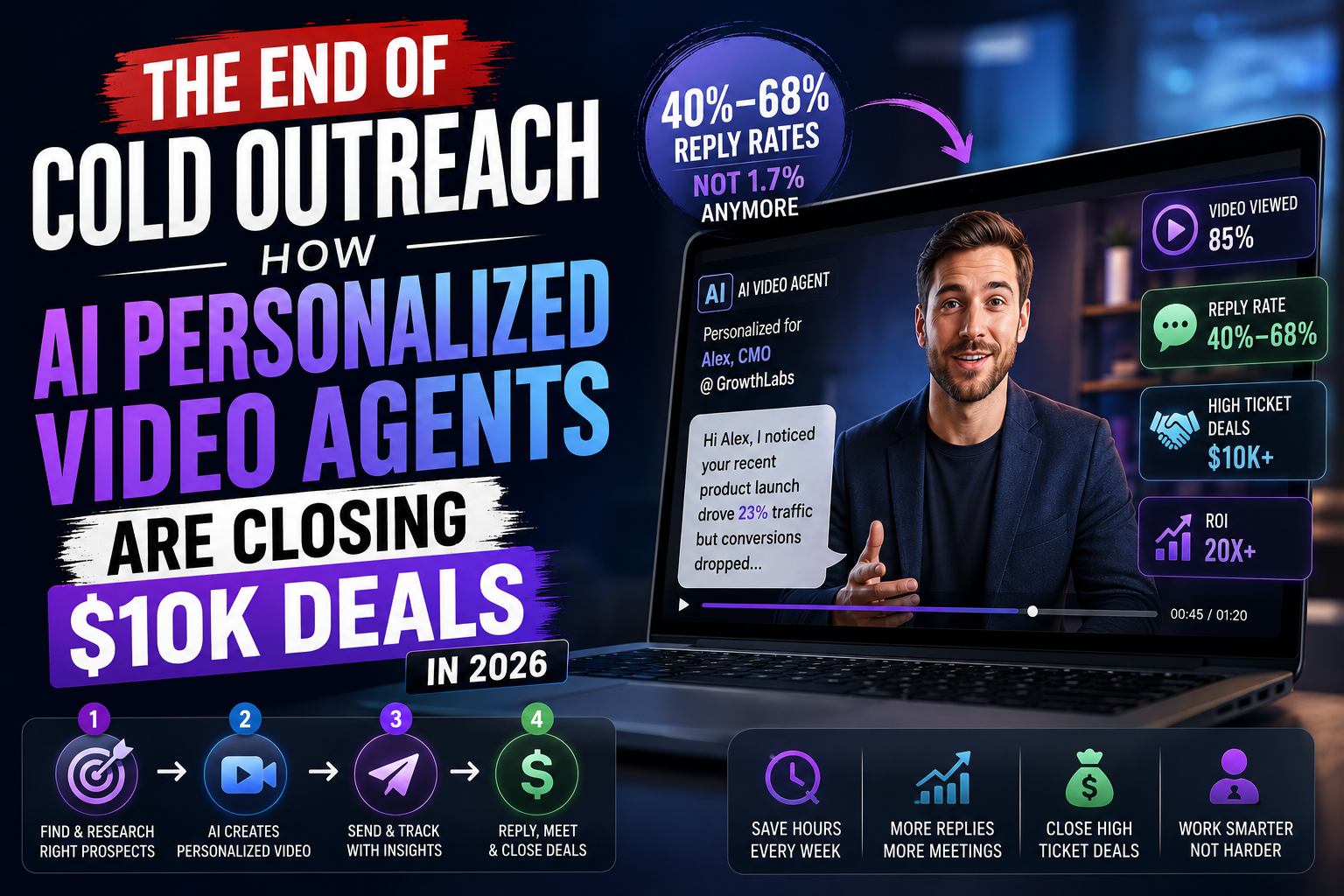
AI personalized video agents are generating reply rates of 40% to 68% in 2026. Sales teams using them are closing $10,000 to $50,000 deals without a single cold call. And the technology is accessible to solo operators — not just enterprise sales floors.
This is not a trend. This is a full shift in how high-ticket deals get closed.
Let me show you exactly how it works.
What You Will Learn:
✅ Why cold outreach died — and what killed it faster than anyone predicted
✅ What AI personalized video agents actually are — no jargon
✅ The exact tools and workflow top closers use in 2026
✅ How to build your own AI video outreach system — step by step
✅ Real numbers: reply rates, deal sizes, and timeline to results
✅ The four mistakes that kill conversion before the video even plays
Jump to: Why Cold Outreach Died | What Are AI Video Agents | Tools & Workflow | Step-by-Step Setup | Mistakes | FAQ
Why Cold Outreach Died — And What Replaced It {#why-dead}
Let me be direct about something most sales trainers still will not admit.
The problem was never the channel. It was the experience on the other end.
Think about it from the recipient’s perspective. You are a decision-maker. Your inbox gets 200 emails a day. Your LinkedIn gets 15 connection requests from strangers. Your phone rings with numbers you do not recognize.
Every single one of those messages says some version of: “Hi [First Name], I came across your profile and thought you might be interested in…”
It is not just annoying. It is actively offensive to people’s time.
And then AI made it worse.
When tools like Apollo, Instantly, and Lemlist made mass personalization easy — everyone did it. Reply rates that were already falling went into freefall. The personalization arms race reached a dead end: when everything is personalized, nothing is.
So what actually works now?
The answer is not more personalization. It is different personalization.
Specifically — personalization that cannot be faked at scale. Personalization that feels like it cost real effort. Personalization that makes the recipient think: “Did someone actually make this just for me?”
That is what AI personalized video agents deliver.
What Are AI Personalized Video Agents — Actually? {#what-is}
Strip away the jargon and here is what this is:
An AI system that creates a unique, short video for each prospect — where a digital human or AI-cloned voice presents a message tailored specifically to that person’s company, role, recent activity, and pain points.
Not a template with their name swapped in. A genuinely different video for each person.
Here is a concrete example of how it works in practice.
You are selling a $12,000 marketing automation package to e-commerce brands. Your target is the CMO of a Shopify store doing $2M in annual revenue.
Old approach: Send an email. Hope they read it. Maybe follow up twice. Close rate: under 2%.
New approach with AI video agents:
The system scrapes the prospect’s LinkedIn, recent company news, their Shopify store, and their social media activity. It identifies a specific, current pain point — say, their abandoned cart rate is high based on public data, or they just ran a sale that underperformed.
It then generates a 60 to 90 second video where an AI presenter (or a cloned version of you) opens with: “I was looking at [Company Name]’s recent Black Friday campaign — specifically the email sequence — and I noticed something that cost you roughly $40,000 in recoverable revenue…”
The prospect clicks play because the subject line referenced something real and specific.
They watch because the first ten seconds prove you actually did your homework.
They reply because no one has ever done this for them before.
This is not science fiction. This is what AI agents are doing across business functions right now — and sales is just the most immediately measurable application.
The Tools That Make This Possible in 2026 {#tools}
You do not need a development team. You do not need enterprise software. Here is the actual stack that works.
Layer 1: AI Video Generation
HeyGen — The current market leader for AI avatar video at scale. Upload a two-minute video of yourself once, and HeyGen clones your appearance and voice. Feed it a script — it produces a video that looks and sounds like you recorded it personally.
Pricing: $29 to $89/month. Output: Unlimited personalized videos from a single recorded source.
What makes it work for outreach: The videos look personal. The uncanny valley problem that plagued early AI video tools has largely been solved. A well-produced HeyGen video in 2026 is indistinguishable from a genuine recording to most viewers.
Synthesia — Better for more polished, corporate-feeling presentations. 230+ AI avatars available if you prefer not to clone yourself.
Pricing: $22 to $67/month.
Best for: B2B SaaS, professional services, financial products.
Tavus — The most sophisticated personalization layer. Tavus does not just swap scripts — it generates genuinely unique video content per prospect, with the AI reading from dynamically generated scripts based on prospect research.
Pricing: Custom — typically $500 to $2,000/month for volume use. Worth it for high-ticket sales.
Layer 2: Prospect Research Automation
Clay — The tool that changed outreach in 2025 and 2026. Clay pulls data from 50+ sources simultaneously — LinkedIn, company websites, news, job postings, funding data, Crunchbase — and uses AI to synthesize a personalized insight for each prospect.
This is the research layer that makes the video content genuinely specific rather than vaguely personalized.
Pricing: $149 to $349/month. The ROI is immediate if your average deal is $5,000+.
Apify + ChatGPT — A cheaper alternative for operators who want to build their own research pipeline. Apify scrapes data, ChatGPT synthesizes it into personalized insights. More technical setup, but total cost under $50/month.
Layer 3: Video Delivery and Tracking
Loom — Still the simplest delivery mechanism. Generate your AI video, upload it to Loom, send the link. Loom tells you exactly when the prospect opened it, how long they watched, and whether they rewatched specific sections.
Vidyard — More enterprise-grade tracking. Integrates directly with Salesforce, HubSpot, and most CRMs. Best for teams.
BombBomb — Purpose-built for video sales outreach. Built-in analytics, easy CRM integration, mobile-optimized playback.
Layer 4: Sequencing and Follow-Up
Here is something most guides miss: the video is not a standalone message. It is the opening of a sequence.
After the video, you need a follow-up sequence that references the video specifically. “Did you get a chance to watch the 90-second breakdown I put together for you?” is dramatically more effective than a generic follow-up.
Instantly or Smartlead for email sequencing. Expandi for LinkedIn automation. Both integrate with the video tools above.
The full stack — Clay + HeyGen + Loom + Instantly — runs under $250/month for a solo operator. That is less than the cost of one hour of enterprise sales consulting.
And this is where the AI agent arbitrage opportunity becomes real: you can build and operate this system for clients as a service, charging $2,000 to $5,000/month per client for setup and management.
Step-by-Step: Building Your AI Video Outreach System {#setup}
Here is the exact workflow. Not theory — the sequence that generates the numbers I mentioned at the top of this article.
Step 1: Define Your ICP with Unusual Specificity (Day 1)
ICP stands for Ideal Customer Profile. Most people define this too broadly.
“E-commerce brands” is not an ICP. “Direct-to-consumer skincare brands on Shopify doing $500K to $5M in revenue with an active email list and a paid social budget” — that is an ICP.
The more specific your ICP, the more specific your video can be. The more specific the video, the higher the reply rate. This is not intuition — it is math.
Spend a full day on this before touching any tools.
Step 2: Build Your Prospect List in Clay (Day 2 to 3)
Import your target companies into Clay. Set up enrichment from LinkedIn, Crunchbase, and their company website. Add a ChatGPT column that synthesizes a “personalized hook” for each prospect — one specific, current, genuine observation about their business.
Target output: 50 to 100 prospects with a unique insight for each.
Example Clay output for one prospect: “Noticed [Company] just opened a second location in Austin — but your Google reviews suggest the customer experience at location 2 is inconsistent with location 1. That gap is where we typically see 15-20% revenue leakage.”
That specific. That personal.
Step 3: Record Your AI Video Template (Day 4)
Record a two-minute “master video” of yourself — good lighting, clear audio, direct eye contact with the camera, natural delivery. This is the source material HeyGen or Tavus will clone.
Then write a 90-second script template with one blank section — the personalized hook from Clay fills this section dynamically.
Structure that converts:
- Line 1 to 3: The specific hook (their company, their current situation, their pain)
- Line 4 to 6: The insight (what you noticed, what it means for them)
- Line 7 to 10: The ask (one specific, low-commitment next step — not “book a call,” but “does this match what you are seeing?”)
Step 4: Generate and Review (Day 5)
Run your prospect list through HeyGen or Tavus. Generate 20 videos as a test batch.
Watch at least five of them personally before sending anything.
AI video tools still make occasional mistakes — pronunciation errors, awkward pauses, mispronounced company names. Catch these in review. One video that mispronounces a prospect’s company name does more damage than no video at all.
Step 5: Send, Track, and Iterate (Week 2)
Send your first batch of 20 to 25 videos. Track opens, watch time, and replies in Vidyard or Loom.
The number to watch is not the reply rate. It is the watch-through rate. If people watch 85% of your video and do not reply — your video is good but your ask is wrong. If people open but only watch 10 seconds — your hook is failing.
Iterate on the weakest link first.
Step 6: Follow Up Intelligently (Ongoing)
For prospects who watched more than 70% of the video and did not reply — send a follow-up that references a specific moment: “You made it to the section about [specific topic] — curious what you thought about that particular point.”
This level of specificity is only possible because you have watch-time data. Use it.
The AI content automation workflow applies here too — once your templates are built, the ongoing operation is largely automated. The human input is the strategy and the iteration, not the execution.
Real Numbers — What to Actually Expect {#numbers}
I want to be honest here because most articles on this topic show cherry-picked results.
Realistic benchmarks from operators using AI video outreach in 2025 and 2026:
Video open rate: 45 to 65% (vs 20 to 35% for text emails)
Watch-through rate (70%+): 55 to 70% of opens
Reply rate: 15 to 35% for well-targeted lists (vs 1 to 3% for cold email)
Meeting booked rate: 8 to 18% of contacted prospects
These are medians. Your results will depend on:
- How specific your ICP is
- How genuinely personalized your hook is
- How strong your offer is
- How well-optimized your follow-up sequence is
The $10K deal math:
If you contact 200 qualified prospects per month, book 20 meetings, and close 20% of those meetings — that is 4 deals per month. At $10K average deal size: $40,000 in monthly revenue from a single outreach system that costs under $300/month to run.
Those are conservative numbers for a well-built system targeting the right buyers.
Four Mistakes That Kill Your Conversion Before the Video Even Plays {#mistakes}
Mistake 1: Generic hooks dressed up as personalization
“I noticed you are in the [industry] space” is not personalization. It is a mail merge with extra steps. The hook must reference something specific, current, and non-obvious — something that proves you actually looked at their business, not just their job title.
Fix: If your hook could apply to 10 other companies without changing a word — rewrite it.
Mistake 2: Making the video too long
Ninety seconds is the ceiling. Sixty seconds is ideal. Every second past ninety costs you watch-through rate — and watch-through rate is your most important metric.
Fix: Record your script, time it, cut everything that is not essential to the hook or the ask.
Mistake 3: Asking for too much in the first video
“Book a 30-minute discovery call” is too much to ask from a cold prospect who has known you for 90 seconds. You are asking them to commit 30 minutes of their time to someone they have never spoken to.
Fix: Ask a question. “Does this match what you are seeing on your end?” or “Would it be useful if I put together a quick breakdown specific to your situation?” — low commitment, high response.
Mistake 4: Sending and forgetting
The first video is the opening line of a conversation, not the whole pitch. Most conversions happen on follow-up two or three — not the first touch.
Fix: Build a three to four step sequence where each message references the previous one and advances the conversation. Never send a generic follow-up.
Who Is Actually Building This in 2026? {#who}
This is not just for enterprise sales teams.
Solo consultants and freelancers are using this to land $5K to $15K projects. The video demonstrates technical sophistication before the conversation even starts — which immediately commands higher rates.
Agency owners are building AI video outreach as a productized service — charging $2,000 to $4,000/month to manage the system for clients. The margins are exceptional because once the system is built, the ongoing work is minimal.
SaaS founders are using it for demos and trials — sending a personalized video that shows the product solving a specific problem the prospect actually has, rather than a generic feature tour.
Recruiters — particularly for senior and executive roles — are finding that personalized video dramatically outperforms InMail for response rates from passive candidates.
If you want to understand how to turn this skill into a scalable income source — the AI agent arbitrage framework is the most practical starting point I have found. It covers building AI-powered services without coding — which is exactly what this system is.
FAQ {#faq}
Do prospects know the video is AI-generated?
Some do. Most do not — and it matters less than you think. What prospects respond to is the specificity and effort the video demonstrates, not the production method. A prospect who watches your 90-second video and hears a specific, accurate insight about their business will respond — regardless of whether the voice is AI-cloned or recorded fresh.
How much does it cost to build this system from scratch?
A functional AI video outreach system costs $150 to $300/month for a solo operator. Clay ($149), HeyGen ($29), Loom (free tier or $15), and Instantly ($37) covers the full stack. Total setup time: one focused week.
What industries respond best to AI personalized video outreach?
B2B SaaS, professional services (consulting, legal, accounting), real estate, recruiting, and high-ticket e-commerce all show strong results. Industries where decisions are made by individual people — not committees — see the highest conversion rates.
Is this compliant with GDPR and CAN-SPAM?
Yes — with proper implementation. Include an easy opt-out in every message. Use prospect data only for outreach purposes. Do not scrape personal data beyond what is publicly available. The tools mentioned above (Clay, Instantly) have compliance features built in — use them.
How is this different from just sending a Loom video?
A self-recorded Loom is personal but does not scale. AI video outreach scales the personalization — you can send 200 genuinely unique videos per week without recording 200 times. The combination of AI research (Clay), AI video generation (HeyGen/Tavus), and intelligent sequencing is what creates the conversion rates that manual video never could.
Conclusion + Next Step
Cold outreach did not die because people stopped wanting to buy.
It died because the experience of receiving it became indistinguishable from spam.
AI personalized video agents solve the experience problem. Not by sending more messages — but by making each message feel like it was made specifically for one person. Because it was.
Three things to do this week: Sign up for a free HeyGen account and record your two-minute source video. Open Clay and build a list of 20 target prospects with specific hooks for each. Send your first five videos and watch what happens to your reply rate.
The technology is here. The competition is not using it yet — at least not well. That gap closes in the next 12 to 18 months.
The best time to build this system is now.
Drop a comment: What industry are you targeting — and what is your current cold outreach reply rate? I will give you a specific hook angle for your niche.
If this changed how you think about outreach — share it with one person on your team who is still grinding through cold email. It might save them weeks of wasted effort.