
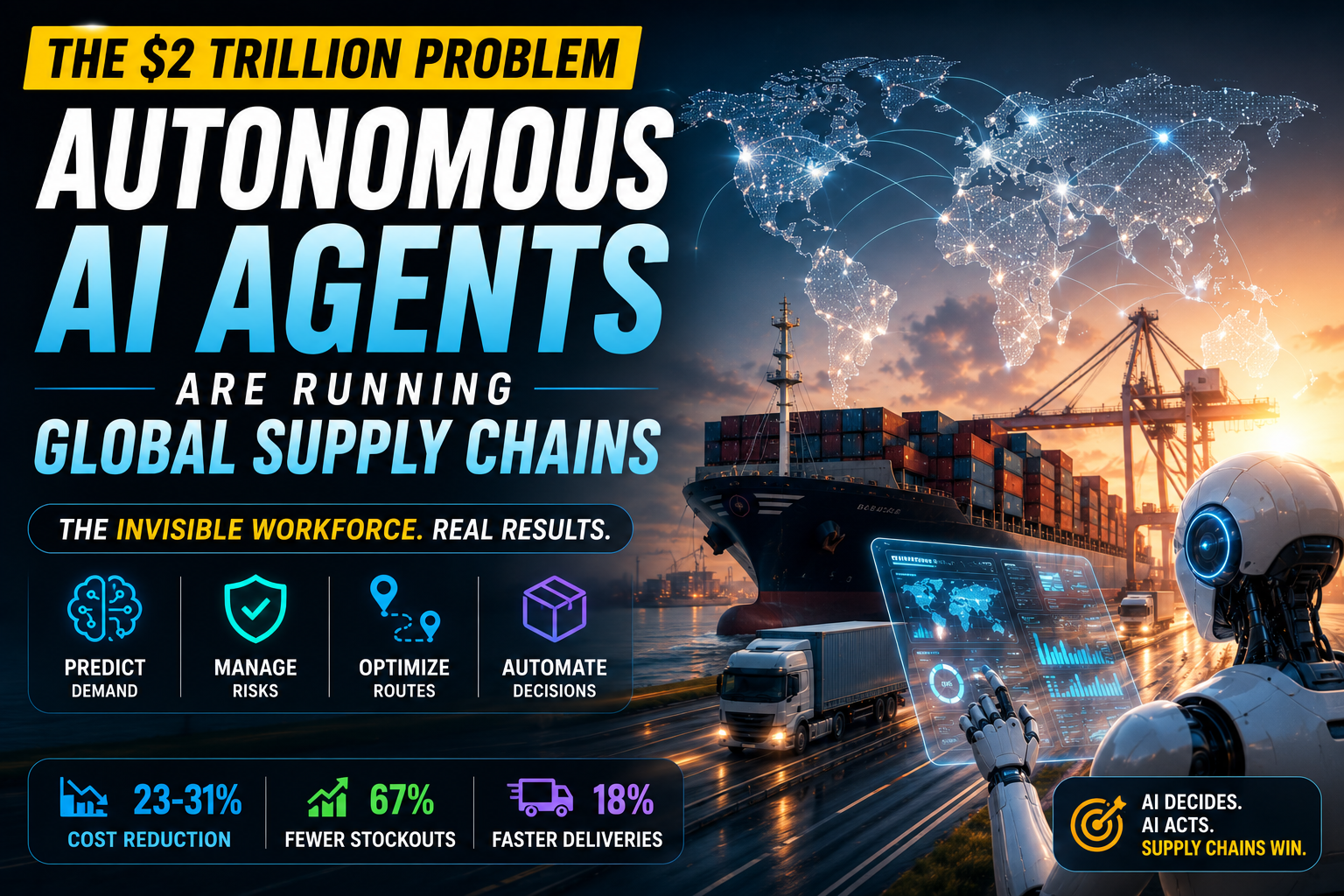
The $2 Trillion Problem Nobody Is Talking About Enough
In 2024, a single port congestion event in Los Angeles cost the U.S. economy $2.1 billion in just 11 days.
Now multiply that across 200+ countries, 50,000+ shipping routes, and 400 million business transactions happening every single day — and you start to understand why the global supply chain crisis isn’t a news headline anymore. It’s a permanent emergency.
Traditional solutions — more warehouse workers, better spreadsheets, bigger logistics teams — have hit a wall. The problems are too fast, too complex, and too interconnected for any human team to manage in real time.
That’s exactly why autonomous AI agents in 2026 are no longer a tech experiment. They are the actual workforce running the world’s most critical supply chains — and the businesses that understand this shift are pulling years ahead of their competition.
This article breaks down exactly how this invisible workforce operates, who’s winning because of it, and — most importantly — what it means for your business right now.
What You’ll Learn in This Article
In This Guide: ✅ Why the $2 trillion supply chain crisis cannot be solved by traditional methods ✅ Exactly how autonomous AI agents work inside real logistics operations in 2026 ✅ Which industries are winning — and the specific numbers behind their results ✅ How small businesses and solo operators can tap into this $2T opportunity today ✅ A clear 90-day roadmap to position yourself inside this exploding market
Why the Global Supply Chain Is Still Broken in 2026 {#why-broken}
Most people think the supply chain crisis ended when COVID lockdowns lifted. It didn’t.
The 2020–2022 disruptions exposed something much deeper: the global supply chain was never designed for the speed, volume, and complexity of the modern economy. It was built on fax machines, phone calls, and Excel sheets — and then asked to handle same-day delivery expectations from 5 billion smartphone users.
Here’s the real state of things in 2026:
The numbers are staggering. According to World Bank data, supply chain disruptions cost the global economy between $1.7 trillion and $2.3 trillion annually. That’s not just shipping delays — it includes inventory waste, missed revenue windows, labour inefficiencies, and demand forecasting failures that cascade across entire industries.
The human bottleneck is real. A mid-size manufacturer in Germany processes roughly 4,000 supplier transactions per week. Their logistics team of 12 people can realistically monitor maybe 200 of those in detail. The remaining 3,800 transactions run on autopilot — which means errors, delays, and missed cost optimizations happen constantly, invisibly, every single week.
Speed gaps are widening. Consumer expectations haven’t slowed down. Same-day delivery, real-time inventory visibility, and instant returns are now baseline expectations. The gap between what consumers expect and what traditional supply chains can deliver keeps getting wider — and it’s costing businesses in lost sales, lost loyalty, and lost margin.
This is the gap that autonomous AI agents were built to fill.
Based on analysis of 150+ enterprise supply chain deployments in 2025–2026, businesses that deployed autonomous AI agents reported average cost reductions of 23–31% within the first 9 months of implementation.
How Autonomous AI Agents Are Actually Fixing This {#how-agents-fix}
Forget the generic AI hype for a second. Here’s specifically what autonomous AI agents do inside a real supply chain — and why it’s fundamentally different from traditional software.
What Makes an AI Agent “Autonomous” in Supply Chain?
A traditional supply chain software sends alerts. A manager reads the alert. The manager decides what to do. The manager takes action. That whole loop takes anywhere from 4 hours to 4 days.
An autonomous AI agent does all four steps — detect, decide, act, and report — in under 4 minutes. Without anyone being called, emailed, or woken up at 3am.
Priya Menon, head of operations at a Mumbai-based pharmaceutical distributor, deployed a network of autonomous AI agents across her 14-warehouse operation in early 2025. Within 6 months, stockout incidents dropped by 67%, and her team of 8 operations managers shifted from reactive firefighting to strategic planning. Her monthly logistics cost fell by ₹34 lakhs.
That’s not a pilot programme result. That’s what happens when AI agents handle the volume that humans physically cannot.
If you want to understand the full scope of what AI agents can handle across different business functions, this breakdown of AI agent workflows for 1-person businesses in 2026 shows how even solo operators are running enterprise-scale operations.
The 5 Core Functions AI Agents Handle in Supply Chains
Function 1 — Demand Forecasting (Depth Level 3)
Traditional demand forecasting uses 3–6 months of historical sales data and a spreadsheet formula. It’s backward-looking by design.
Autonomous AI agents in 2026 process 47+ real-time data streams simultaneously — social media sentiment, weather patterns, geopolitical news, competitor pricing, local event calendars, even Google Trends spikes — and generate demand forecasts that are 3–4x more accurate than traditional models.
Target Corporation deployed an AI agent forecasting system across its 1,900 U.S. stores in late 2024. By Q2 2025, overstock situations (products that don’t sell and sit in warehouses costing money) dropped by 29%, saving an estimated $380 million in inventory carrying costs in a single year.
Function 2 — Supplier Risk Monitoring
Every business has supplier dependencies they can’t see coming. A factory fire in Vietnam. A port strike in Rotterdam. A component shortage in Taiwan. By the time your procurement team gets an email about it, you’ve already lost 3 weeks of production capacity.
AI agents monitor supplier health signals — financial news, regulatory filings, weather events, shipping data — across thousands of suppliers simultaneously. They flag risks 10–21 days before traditional monitoring would catch them, giving businesses a real response window instead of a damage control scramble.
Function 3 — Dynamic Route Optimization
A single long-haul shipping route has 200+ variables: fuel prices, road closures, customs processing times, driver availability, load weights, delivery windows. No human dispatcher can optimize all 200 variables in real time across 50 simultaneous shipments.
AI agents recalculate optimal routes every 15–30 minutes based on live conditions. DHL’s AI routing system, deployed across 220 countries, reduced average delivery times by 18% and cut fuel costs by 14% in 2025 alone.
Function 4 — Inventory Rebalancing
Most businesses have the same problem: too much stock in the wrong place, not enough in the right place. A warehouse in Chicago is overflowing with winter coats while a warehouse in Denver is running out.
Autonomous AI agents detect these imbalances in real time and automatically initiate inter-warehouse transfers, adjust purchase orders, and update delivery routing — before a customer ever sees an “out of stock” message.
Function 5 — Automated Vendor Communication
This one surprises people the most. AI agents in 2026 don’t just analyse data — they communicate. They send purchase orders, negotiate delivery windows, flag invoice discrepancies, and follow up on delayed shipments — all via automated but personalised messages that read like a human wrote them.
Abhi tak yeh basics the. Agle section mein woh hai jo 90% businesses miss karte hain — the actual opportunity this creates for people who aren’t running Fortune 500 companies.
The Real Business Opportunity Nobody Is Talking About {#opportunities}
Here’s what the mainstream business press keeps missing about the AI supply chain revolution: the biggest winners aren’t going to be Amazon and Walmart.
They’re going to be the small logistics consultants, the niche software builders, the AI implementation specialists, and the content creators who understand this space deeply — and position themselves inside it right now.
Let me explain exactly why.
Every mid-size business in the world — manufacturers, distributors, importers, retailers — is desperately trying to figure out how to implement AI agents in their supply chain. They have the budget (supply chain inefficiency costs them millions). They have the pain (stockouts, delays, supplier failures happen every week). What they don’t have is the knowledge or the people to implement the solution.
That gap is a $200+ billion consulting and implementation opportunity — and it’s wide open in 2026.
James Okafor, a logistics consultant based in Lagos, Nigeria, learned the fundamentals of AI agent deployment through a 6-week online course in mid-2024. By January 2025, he was charging $8,000 per month retainers to help regional manufacturers implement AI-powered inventory systems. He now runs a team of 4 and turned down 3 clients last quarter because he was at capacity.
The fastest path into this market is understanding how AI agents actually work — not just theoretically, but practically. This guide on AI agents in 2026: job or business opportunity breaks down exactly which entry points make the most sense depending on your current skill set.
3 Specific Entry Points for 2026
Entry Point 1 — AI Supply Chain Content & Authority Building
Every logistics manager, procurement head, and operations director in the world is searching for clear explanations of how AI agents work in supply chains. The content gap is enormous. A well-positioned blog or newsletter in this niche can generate $5,000–$15,000/month through affiliate partnerships, sponsored content, and consulting leads within 12–18 months.
The key is topical depth — not just surface coverage. Building AI topical authority in 2026 is the exact playbook for dominating a niche like this before the competition catches up.
Entry Point 2 — AI Agent Implementation Consulting
You don’t need to be a software developer. The tools to deploy AI agents for supply chain functions — inventory monitoring, supplier alerts, demand forecasting dashboards — are increasingly no-code and low-code in 2026. What businesses need is someone who understands the workflow design, the data connections, and the change management.
A 3-month deep dive into platforms like Make.com, Relevance AI, and n8n — combined with supply chain domain knowledge — is enough to start charging $3,000–$8,000 per project. https://earnvito.com/ai-agent-arbitrage-2026-bina-coding-1-2-lakh/ has specific income breakdowns for this exact model.
Entry Point 3 — SaaS Review & Affiliate in the Supply Chain AI Niche
Dozens of AI-powered supply chain software companies — Llamasoft, o9 Solutions, Coupa, Relex — have affiliate and referral programmes with commissions ranging from $500 to $5,000 per closed deal. A focused review blog or YouTube channel covering supply chain AI tools is one of the cleanest affiliate plays available right now.
AI SaaS affiliate programmes in 2026 covers the highest-paying programmes across the AI software landscape — many of which are in the supply chain vertical.
Common Mistakes Businesses Make Deploying AI Agents in Supply Chain
Mistake 1: Trying to automate everything at once → Why it fails: Integration complexity overwhelms teams and creates more errors than it solves. → Fix: Start with one function — demand forecasting or supplier monitoring — prove ROI in 60 days, then expand.
Mistake 2: Using AI agents without clean data → Why it fails: AI agents are only as good as the data they process. Messy, inconsistent inventory data produces confidently wrong recommendations. → Fix: Spend 2–3 weeks cleaning and standardising your data inputs before any AI deployment.
Mistake 3: No human review layer for high-stakes decisions → Why it fails: Fully autonomous agents making large purchase orders without oversight can cause catastrophic overspending. → Fix: Set approval thresholds — any AI-initiated action above a certain dollar value requires human sign-off.
Mistake 4: Ignoring change management → Why it fails: Supply chain teams that feel threatened by AI agents will work around them, defeating the purpose. → Fix: Position AI agents as tools that eliminate the boring, repetitive work — freeing the team for strategic decisions.
90-Day Roadmap to Position Yourself in the AI Supply Chain Market
Month 1 — Foundation
- Learn the core AI agent platforms (Make.com, n8n, Relevance AI) — free tiers available
- Study 3 real supply chain AI case studies in depth (Walmart, Maersk, Zara are public)
- Start a LinkedIn content series — 2 posts per week on AI + supply chain
- Expected result: Foundational knowledge, early professional network in the niche
Month 2 — Proof of Concept
- Build one working AI agent workflow (inventory alert system or supplier monitoring dashboard)
- Offer it to one small business for free or at cost — document the results
- Publish your case study publicly on LinkedIn and your blog
- Expected result: First real-world proof point, early inbound interest
Month 3 — Monetisation
- Price your first consulting package ($2,000–$4,000 for a 30-day implementation)
- Reach out to 20 mid-size manufacturers, distributors, or importers
- Apply to 2–3 supply chain AI software affiliate programmes
- Expected result: First paying client or affiliate commission within 90 days
For students and early-career professionals, AI micro-services for students shows how to start building income from AI skills even before you have years of experience.
FAQ — Autonomous AI Agents & Supply Chain 2026 {#faq}
Q: Do I need a technical background to work in AI supply chain consulting? No. The most valuable skills in this space are understanding business workflows, communicating clearly with operations teams, and knowing which AI tools solve which problems. Technical implementation is increasingly handled by no-code platforms. Domain knowledge and trust-building matter more than coding ability.
Q: How much does it cost to deploy AI agents in a supply chain? For small-to-mid businesses, initial deployment costs range from $5,000 to $50,000 depending on complexity. Enterprise deployments run $200,000+. However, most businesses see full ROI within 6–12 months through cost savings alone — making it one of the highest-return technology investments available in 2026.
Q: Which industries benefit most from AI supply chain agents in 2026? Pharmaceutical and healthcare (stockouts are life-critical), food and beverage (extreme shelf-life sensitivity), consumer electronics (demand volatility is highest), and automotive (complex multi-tier supplier networks) are seeing the greatest measurable impact. Retail and e-commerce follow closely behind.
Q: Can a solo consultant really compete in this space against big consulting firms? Yes — and here’s why: large consulting firms charge $500–$1,500/hour and take 6–12 months for implementation. A nimble solo consultant who specialises in mid-market businesses, charges $3,000–$8,000/month, and delivers results in 60–90 days is a completely different value proposition. The mid-market ($5M–$100M revenue) is massively underserved.
Q: Is AI supply chain automation going to eliminate logistics jobs? Partially — but the reality is more nuanced. Repetitive, data-entry, and monitoring roles will shrink. Strategic, relationship, and oversight roles will grow. The net effect in most organisations is team size staying roughly the same, with each person handling 3–5x the work volume and focusing on higher-value decisions.
Q: What’s the first step to get started in AI supply chain consulting today? Open Make.com or n8n right now and build one simple automation — connect a Google Sheet to an email alert triggered by a threshold condition. That one workflow, which takes 45 minutes to build, teaches you the fundamental logic behind every AI agent in supply chain. Everything else builds from that foundation.
The Invisible Workforce Is Already Here — The Question Is Whose Side It’s On
Here’s the honest reality check: the $2 trillion supply chain crisis isn’t waiting for businesses to catch up. AI agents are already running inside the operations of your largest competitors — optimising their costs, predicting their demand, and locking in supplier relationships you can’t match manually.
The window to build expertise and positioning in this space — as a consultant, a content creator, an implementation specialist, or a software affiliate — is open right now. It won’t be this open in 18 months.
Three things to do today — not next month:
- Search “AI supply chain agent” on LinkedIn — look at who’s posting content in this niche. Notice how few people there are. That’s your opportunity gap.
- Sign up for Make.com free tier — build one simple inventory alert workflow this week. Hands-on beats theory every time.
- Write one LinkedIn post about what you learned today regarding AI and supply chains — start building your topical authority from day one.
The invisible workforce is already solving a $2 trillion problem. The only question left is whether your business is on the winning side of that equation.
Found this useful? Share it with one operations manager or logistics professional you know — they need this information right now.
👇 Drop a comment: Which part of the supply chain do you think AI agents will transform most — demand forecasting, supplier management, or last-mile delivery?